HONDA 16210-HE0-000 Intake Carburetor Boot Vforce Reed Block
fits model: Fl400, Fl400r, Pilot. make: Honda. year: 1989–1990.
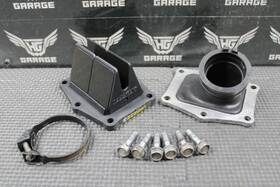
( Manufacturer Part Number: 16210-HE0-000 ), ( Type: Intake Boot Reed Block )
Review HONDA Oem Intake Carburetor Boot Vforce Reed Block fits PILOT FL400 FL400R 1989–1990
The **Honda 16210-HE0-000 Intake Carburetor Boot and Reed Block Assembly** for the **1989 1990 Honda Pilot FL400/FL400R** is a meticulously engineered component designed to ensure optimal airflow and performance in the motorcycle s carbureted fuel delivery system. This high-quality rubber boot and reed block assembly serves as a critical interface between the air filter and the carburetor, playing a vital role in maintaining precise throttle response, smooth operation, and overall engine efficiency. Crafted from durable, heat-resistant rubber, the boot is engineered to withstand the demands of off-road riding, protecting the delicate reed valves from dust, debris, and moisture while allowing unrestricted airflow into the carburetor. The reed block itself is a precision-molded assembly featuring a series of flexible reeds that open and close in response to air pressure, regulating the intake of fuel-air mixture into the carburetor with remarkable accuracy. This design minimizes vacuum loss and ensures consistent power delivery, whether cruising on paved roads or tackling rugged trails. The **V-Force** designation indicates its compatibility with Honda s **CV carburetor** system, which was standard on the FL400/FL400R models during these years, providing a seamless fit with minimal modifications required. Whether replacing a worn-out boot or addressing a reed block failure commonly signaled by rough idling, hesitation, or reduced power the 16210-HE0-000 assembly offers a direct, OEM-quality replacement that restores factory performance and reliability. Its straightforward installation and long-term durability make it an essential part for riders seeking to maintain their classic Honda s original mechanical integrity.
### **Pros and Cons of Buying a 1989-1990 Honda Pilot FL400/FL400R Intake Carburetor Boot (V-Force Reed Block)**
#### **Pros:**1. **Reliability and Durability** Honda s carbureted engines from this era are known for their robustness, especially the FL400 series, which was designed for off-road use. With proper maintenance, these engines can last decades with minimal issues.
2. **Off-Road Capability** The FL400/FL400R was built for rugged terrain, making it a strong choice for trail riding, dirt jumping, or light off-road work. The V-Force reed block helps prevent backfiring and improves throttle response in rough conditions.
3. **Simplicity and Repairability** Carbureted engines are generally easier to diagnose and repair than fuel-injected models. Many mechanics and DIY riders are familiar with carburetor tuning, making maintenance more accessible.
4. **Aftermarket Support** There is a strong aftermarket presence for Honda s older models, including performance carburetor kits, reed blocks, and intake boots. Upgrading components is relatively straightforward.
5. **Lower Cost of Ownership** Parts for these bikes are often cheaper than modern counterparts, and labor costs for basic repairs are generally lower. Fuel efficiency is decent for a carbureted ATV, though not as good as modern fuel-injected models.
6. **Classic Appeal** If you enjoy vintage or retro-style ATVs, the FL400 s design has a nostalgic charm that appeals to enthusiasts who appreciate mechanical simplicity and raw power.
7. **Good Power-to-Weight Ratio** The FL400 produces around 30-35 horsepower, which is sufficient for most off-road tasks, including towing light trailers or carrying passengers on rough terrain.
8. **Ease of Modification** The carburetor setup allows for easy tuning with adjustments to the float level, jets, and throttle response, making it simple to optimize performance for different riding conditions.
---
#### **Cons:**1. **Poor Fuel Efficiency** Carbureted engines are less efficient than modern fuel-injected models, consuming more gas per mile. Expect around 40-60 mpg in light off-road use, which can add up over time.
2. **Maintenance Requirements** Carburetors require regular cleaning and adjustment to prevent clogging, flooding, or lean-running issues. Ignoring maintenance can lead to poor performance or engine damage.
3. **Emissions Concerns** Older carbureted engines do not meet modern emissions standards, which could be an issue if you ride in areas with strict environmental regulations or plan to use the ATV in urban settings.
4. **Limited Modern Technology** Unlike newer ATVs, the FL400 lacks features such as electronic fuel injection, traction control, or advanced suspension tuning. This can limit performance in extreme conditions.
5. **Potential for Wear** The V-Force reed block and intake boot are designed to reduce backfiring, but they can wear out over time, especially if the engine is heavily modified or abused. Replacing them may require some mechanical skill.
6. **Resale Value** Vintage ATVs like the FL400 hold value among collectors but may depreciate faster than newer models. If you plan to sell later, the market for these bikes is niche.
7. **Noise and Vibration** The FL400 s engine is loud and can produce significant vibration, which may be uncomfortable for long rides. Modern ATVs often have better sound insulation and smoother operation.
8. **Limited Availability of New Parts** While parts are still available, some components (e.g., specific carburetor models, seals, or electrical parts) may become harder to find over time, increasing repair costs.
---
### **Conclusion:**The **1989-1990 Honda FL400/FL400R intake carburetor boot (V-Force reed block)** is a solid choice if you prioritize **off-road reliability, simplicity, and a classic riding experience**. It excels in rugged conditions and offers easy modifiability, making it ideal for enthusiasts who enjoy tinkering with their machines. However, it comes with trade-offs in **fuel efficiency, maintenance demands, and modern conveniences**.
If you re looking for a **durable, low-maintenance off-road ATV** and don t mind the drawbacks of a carbureted engine, this part is a worthwhile investment. For those seeking **fuel efficiency, emissions compliance, or advanced features**, a newer model with fuel injection would be a better fit.
---
### **Recommendation:**- **Buy it if:** You need a **reliable, off-road-focused ATV** for light to moderate use, enjoy working on your own machine, and don t mind the carburetor s quirks. It s an excellent choice for **trail riding, farming, or casual off-roading** where simplicity and ruggedness matter more than modern tech.
- **Avoid it if:** You prioritize **fuel efficiency, low maintenance, or plan to ride in urban or emissions-restricted areas**. Additionally, if you re not comfortable with carburetor tuning or basic engine maintenance, the FL400 may frustrate you over time.
For the best experience, **inspect the carburetor, reed block, and intake boot for wear** before purchasing, and ensure the engine is in good condition. If you re buying used, test the ATV thoroughly to confirm it runs smoothly and doesn t have hidden issues.
Details:
Removed from a good running machine. No broken reed petals. No cracking or holes in intake boot. Rubber is pretty stiff, but still has some flex to it and functions as should.
Removed From: 1989 Honda Pilot 4 Please review all pictures to assess the condition of item. 1989 1990 HONDA PILOT FL400 FL400R OEM INTAKE CARBURETOR BOOT VFORCE REED BLOCK, This intake boot with Vforce 3 reed block is in good condition and shows normal signs of wear.
part #: 16210he0000 prices
- $65.00-$300.00
specifications carbthrotatv:
- for models: Fl400, Fl400r, Pilot
- for makes: Honda
- for years: 1989-1990
- mpn: 16210-he0-000
- type: Intake Boot Reed Block
shipping carbthrotatv:
- type: Fixed
- cost: $0.00
- service: USPS Priority Mail
- class: Expedited
- carrier: USPS
- transit: 3-9 Days
payments carbthrotatv:
- other
- credit card: Diners-club
- wallet: Paypal
seller carbthrotatv:
- city: Boylston, Massachusetts
- rating: 99.9%
- # reviews: 2361
general carbthrotatv:
- ATV, Side-by-Side UTV Parts Accessories > Air Intake Fuel Delivery > Carburetors
- condition: Used
returns carbthrotatv:
- paid by: Buyer
- time: 30 Days
- policy: Returns Accepted
offer carbthrotatv:
- quantity: 1
- options: Ship-to-home
- started: May 12, 2026
- sold: 0
- availability: In Stock
Honda 16210-HE0-000 Is Similar To:
- 01mv3a Maxpeedingrods Carburetor For Honda Carb (28.6% similar) 2ND at 5:00AM APR. 1ST at 5:00AM APR. 1x black throttle base cover. How much does delivery cost and long will it take. For honda TRX450FE, TRX450FM foreman quantity: 1x carburetor. 1ST at 4:30AM APR. If you paid item shipped on est...(October 29th, 2018)
- 03a5kg Maxpeedingrods Genuine Quality Carburetor Carby For Honda Trx Rancher (26% similar) For example, you paid at 11AM on Nov. Return items must be in original condition. The same rule applies to ups 2ND day air service. 1x throttle base cover screw. Return item must be in brand new and unused condition with original tags packaging. O ther items you might also like for BMW 320D x3 M47TU...(June 22nd, 2018)
- 092307-11008 1986 Atc250sx 1985 Carb 1987 Honda Carburetor (21.2% similar) ...(August 13th, 2015)
- 0f3h9i Maxpeedingrods Carburetor For Honda Heat Sensor Bin (33.1% similar) 7TH after APR. How much does delivery cost and long will it take. 1x throttle base cover screw. 1ST at 5:00AM APR. Opening hours: 7X24 hours, always here for you. 2ND at 5:00AM APR. 1x black throttle base cover. For honda TRX 450ES foreman 450FE 450FM TRX450S quantity: 1x carburetor. Favorite search...(March 4th, 2019)
- 0qwrzd Maxpeedingrods Carburetor Fit Honda (31.1% similar) Honda TRX 450ES foreman 450FE 450FM TRX450S quantity: 1x carburetor. 1ST at 5:00AM APR. 7TH after APR. How much does delivery cost and long will it take. 2ND at 5:00AM APR. Opening hours: 7X24 hours, always here for you. 1x black throttle base cover. 1ST at 4:30AM APR. If you paid item shipped on ...(January 16th, 2018)
- 11-11-14 Honda Trx Carburetor Assembly (32.1% similar) Brand: handcart type: carburetor assembly manufacturer part number: engine model: TRX 250 footrace condition: used works comments: this was working when removed. Special exclusions or considerations are listed in the comments below. Derricks outboards is selling this item for immediate purchase...(June 14th, 2018)
- 16013-hn5-671 Honda Atv Carburetor Float (31.6% similar) ...(May 6th, 2018)
- 16014-men-732 Honda Kehin Fcr Carb Carburetor Slide Top Cover Cap (35.4% similar) Machines listed above can use alternate parts on model's stated depending build date, trim and specific model the way manufactures state their fitment guides. Note: if there is an application guide posted above, it just that, a guide, not all inclusive list. This is in good used condition and shows ...(February 1st, 2019)
- 16015-hm8-000 Honda Nos Oem Carburetor Float Bowl Chamber Recon Sportrax (38.8% similar) New oem honda carburetor bowl for your recon and Sportrax 250 model's listed. Highest quality oem part for less...(March 2nd, 2018)
- 16015-hn1-003 Honda Carburetor Carb (28.1% similar) Could use a quick cleaning. Items are shipped using USPS, ups, and FedEx. Please through messages. Was removed from a running 2002 honda TRX400EX. Has light wear. Carburetor is in good condition. Comes as pictured...(March 27th, 2019)
- 16016-hm5-730 Honda Carburetor Screw Set Nos (29.2% similar) Absolutely no disappointments. Honda TRX400 TRX300 Sportrax footrace carburetor screw set nos. Part number HM5-730...(November 6th, 2018)